
Pixels only
No internet access required, no OCR, no label recognition, no agentic search. No EXIF, no web search, no database lookups. The prediction comes from the image itself, so it works on photos that were never posted online.
The AI location finder that geolocates any photo from pixels alone, with no GPS and no EXIF. Sub-second results, worldwide.
Any photo or screenshot. The file header is thrown away before analysis.
Architecture, terrain, vegetation and signage are weighed across the frame.
Country, region, city, and the confidence radius that comes with it.
How it works
No metadata is read at any stage. The pipeline sees pixels, weighs visual cues, and returns a place with its confidence radius.
01
The image is decoded and the file header discarded. EXIF and GPS fields are never parsed, so stripped or spoofed metadata changes nothing.
02
Architecture, terrain, vegetation, road markings and infrastructure are scored across the whole frame, the cues an analyst would name, at scale.
03
You get country, region and city, street level where the scene is distinctive, each with the confidence radius printed next to it.
Run it on one of your own photos, no account needed.
Try it nowThe model
Five families of visual evidence, weighed at once. Nothing outside the frame is used, no web search, no database lookups.
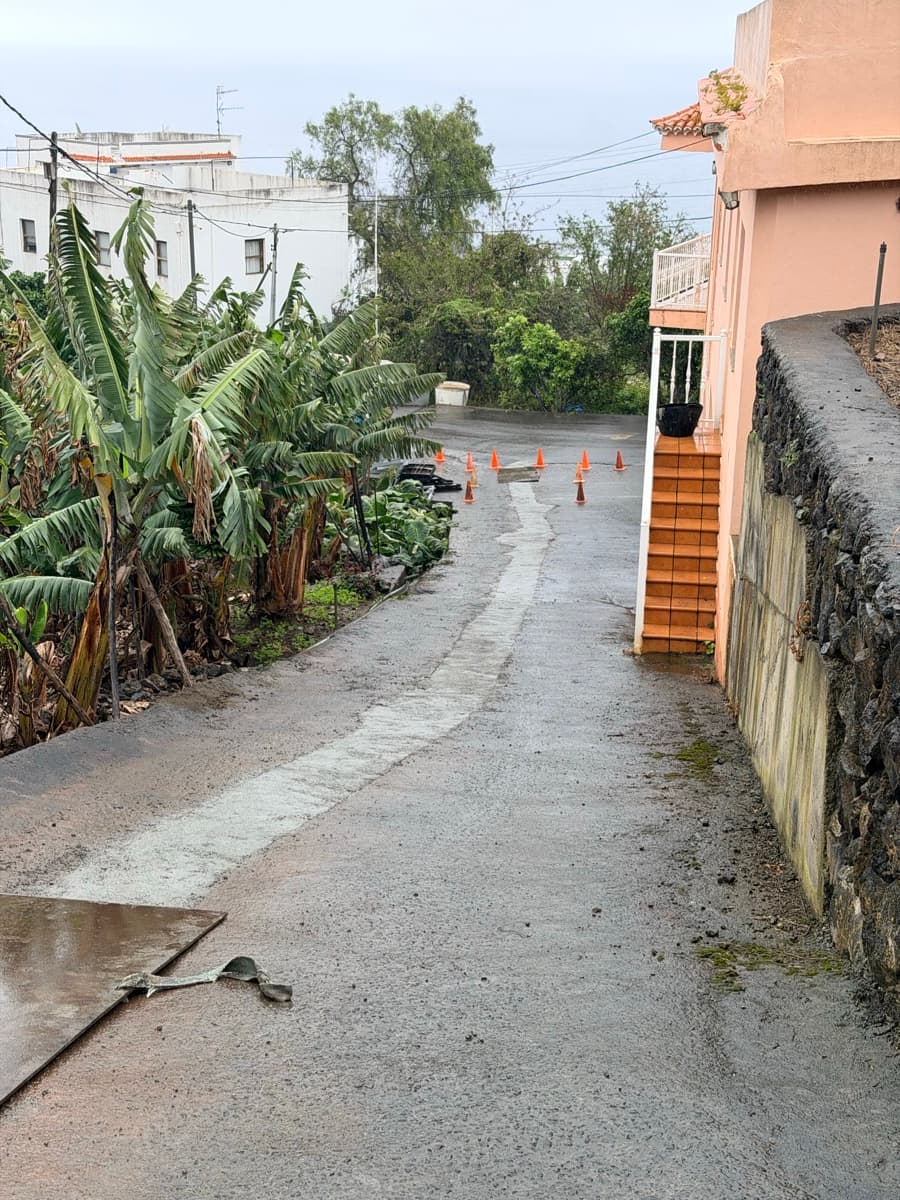
Render finish and colour, roof tiles, balustrade profile, window rhythm, here, flat-roofed white blocks with terracotta ridge tiles.
92%
Species mix and canopy state. Banana stands beside a paved lane narrow this to a subtropical, cultivated island slope.
86%
Overhead cabling on concrete poles, kerb profile, the painted centre strip and cone spacing.
79%
Downhill gradient towards a hazy sea horizon, overcast flat light, wet volcanic surface.
74%
Dry-stone basalt retaining wall with mortar joints and moss, a regional building method, not a global one.
68%
No facial recognition, ever.
Accuracy
Image geolocation is probabilistic. We publish how the model performs at every distance threshold, not a single flattering number.
≤ 1 km
Street
The exact spot
≤ 25 km
61.20%
City
The right metro area
≤ 200 km
78.93%
Region
The right region
Country
93.3%
Country
The right country
Measured on the IM2GPS3k benchmark. Accuracy stays consistent across scene types; the model performs the same way whether the location is common or rare. * known areas.
No internet access required, no OCR, no label recognition, no agentic search. No EXIF, no web search, no database lookups. The prediction comes from the image itself, so it works on photos that were never posted online.
Coming as a separate, explicitly-labeled mode. It will cross-reference external sources for tighter results, so you always know whether a result came from pixels alone.
Capabilities
Visual-only analysis that works when metadata is stripped, spoofed, or never existed.
Works when EXIF is stripped by social platforms, messaging apps, or manual removal. The model reads the image, not the file header.
Location predictions in under a second. Fast enough for live investigative workflows and real-time content review.
Works in remote areas where Street View has no data. Urban cores, rural regions, conflict zones, anywhere on Earth.
Your evidence never trains our public models. Zero-retention policies, AES-256 encryption, and full audit trails for chain-of-custody.
Determine location from the image alone, in environments where GPS is unavailable, jammed, or blocked. No satellite signal required.
Process thousands of images in a single workflow. RESTful API for direct integration into investigation or compliance pipelines. Edge-native infrastructure scales horizontally without limits, no throughput ceiling under batch or high-frequency API load.
Use Cases
From insurance fraud detection to forensic evidence analysis, the platform works across sectors where location verification matters.
Visual intelligence for government agencies and national security. High-precision geolocation for strategic intelligence, border security, and infrastructure monitoring.
Geolocate visual evidence in criminal investigations. Authenticate photographs, verify crime scene locations, and analyze digital content for legal and forensic cases.
Verify insurance claim locations and detect fraud through image analysis. Validate damage claims, verify assets, and check visual evidence against claimed locations.
Geolocation infrastructure for large organizations. API access, custom models, dedicated infrastructure, and support.
Verify the origin and location of images in investigative stories. Useful for fact-checking, source verification, and OSINT investigations.
FAQ
Common questions about GeoInfer and how image geolocation works.
GeoInfer geolocates images using AI, without GPS, EXIF, or any metadata. Upload a photo, and the model analyzes visual cues like architecture, terrain, vegetation, and infrastructure to determine where it was taken. Results in under a second, from anywhere in the world.
Upload it to GeoInfer. You get ranked places with GPS coordinates in about a second. No EXIF or GPS needed, so screenshots work too.
GPS-denied refers to environments where satellite positioning is unavailable, jammed, spoofed, or intentionally blocked. GeoInfer works from pixels alone, no GPS signal, no cell tower data, no metadata. This makes it useful in conflict zones, areas with signal jamming, and any situation where traditional positioning doesn't work.
Yes. GeoInfer doesn't use EXIF or GPS data. Social platforms and messaging apps strip location metadata automatically, and many images never had it to begin with. Our models analyze the visual content of the image itself, which is what makes this approach different from metadata-based tools.
We publish the full accuracy curve rather than a single number. On IM2GPS3k the model lands within 1 km of the true spot 50% of the time, within 25 km 61.2%, within 200 km 78.9%, and gets the country right 93.3% of the time, from the pixels alone. For investigative work, narrowing to the right region in under a second, then verifying, is the workflow that matters.
Under a second. The inference pipeline processes images in milliseconds, fast enough for live investigative workflows and high-volume batch processing. Results come back as soon as you upload.
Defense and intelligence agencies, law enforcement, insurance fraud investigators, investigative journalists, security analysts, and enterprise teams. Also used by visual geography enthusiasts, GeoGuessr players, and geography educators to identify location cues in images. Common professional uses: digital forensics, claims verification, source authentication, GPS-denied operations, and content provenance.
Yes. GeoInfer reads the same visual cues a skilled GeoGuessr player learns to spot, architecture style, road markings, vegetation type, terrain, and infrastructure. Upload a screenshot and the model returns a predicted location with a confidence radius. It's also useful for training: seeing which cues the model weighs most can sharpen your own pattern recognition for visual geography. The Chrome extension puts this inside GeoGuessr: press ⌘ Shift G (Ctrl Shift G on Windows) during a round for coordinates, a confidence radius and a mini map. Get the extension.
Yes. GeoInfer works with both ground-level and aerial imagery. Street scenes, building facades, and landscapes are geolocated using architectural and environmental cues. Aerial and UAV imagery is supported via the Pro tier, which handles overhead perspectives using terrain, land cover patterns, and infrastructure geometry.
We're on a SOC 2 certification path. Institutional users can opt for zero-retention policies, on-premise deployment, and air-gapped deployments, your data stays in your systems and never trains our public models. AES-256 encryption, full audit trails, and custom data handling agreements are available.
Try the demo in your browser — no account needed. Community API access is credit-based (top-ups start at $4.99). For Pro access with meter-level precision, on-premise deployment, or institutional licensing, contact our team at contact@geoinfer.com.
Start now
It runs in the app with no account. Region-level answer in about a second, then decide.